A Lock of Hair: Isola Wilde, Requiescat, and the Ghost at the Heart of Oscar’s Art
Long before Oscar Wilde became the most talked-about writer in London, he was simply a boy called Oscar who adored his little sister. Isola Francesca Emily Wilde was nine years old when she died in 1867. Oscar was twelve. Her death shattered the Wilde household, and for Oscar it never quite healed. Decades later he would write one of his most haunting poems, Requiescat, in memory of Isola Wilde – a quiet elegy about a small grave, a folded shroud, and a love that refused to forget.
This page is about that loss: about the child who disappears from the family photographs, the lock of hair kept in a locket, and the way a single death can echo through a lifetime of art. To understand Isola Wilde is to understand the tenderness beneath Oscar’s wit – and the ache that still pulses through some of his most beautiful lines.
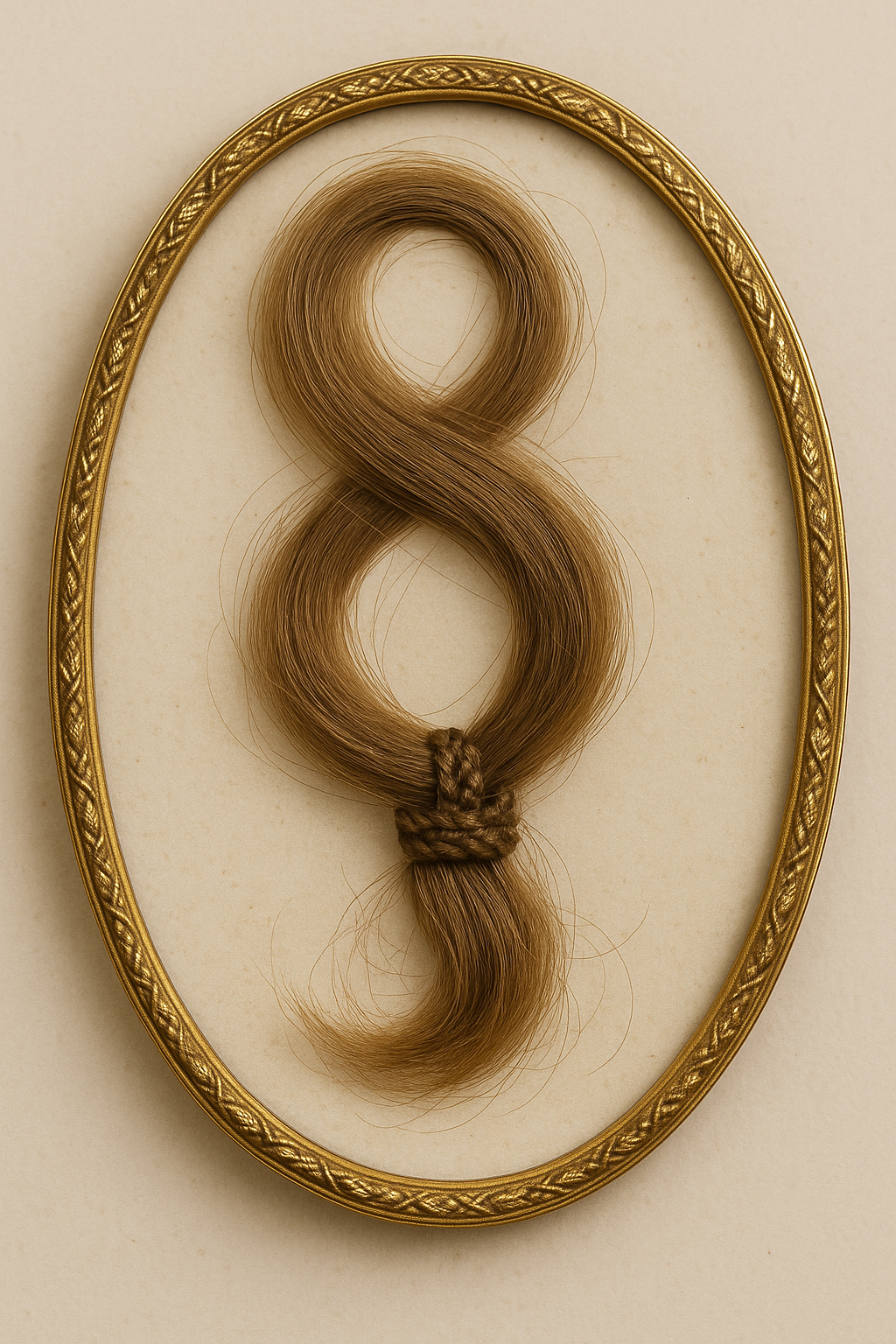
A Victorian hair keepsake – the kind of locket that might have held a lock of Isola Wilde’s hair.
The sister Oscar Wilde could not forget
Isola Wilde was born in 1858, the youngest child of Sir William Wilde and Jane, Lady Wilde. In later biographies she often appears only in passing – a name, a date, a sad sentence about “a favourite sister who died young.” But in Oscar’s own memories she was vivid: golden, gentle, and adored. Family friends remembered them as inseparable when they were children in Dublin, sharing games, secrets, and stories.
In 1867 Isola fell ill while staying with relatives in the countryside. The details are blurred by time and conflicting reports – perhaps meningitis, perhaps a sudden fever – but the outcome is painfully clear. She died away from home. Oscar did not see her again. For a boy who believed in the romance of loyalty and devotion, this distance at the moment of loss became its own kind of wound.
In the Victorian world, grief had rituals: black armbands, closed curtains, formal mourning clothes, carefully staged studio portraits of the dead. In the Wilde family, one of the most intimate relics was said to be a lock of Isola’s hair, curled and preserved in a locket. For Oscar that locket became a portable grave: a tiny, tangible trace of the sister he had lost, kept close to his chest like a private prayer.
Requiescat: a poem of whispers and white violets
Many years later, when he was a young man at Oxford, Oscar Wilde began to shape his grief into words. The poem Requiescat was not published until the 1880s, but its roots lie in that childhood loss. The title means “may she rest” – a single Latin word often carved onto Victorian gravestones. Wilde builds the poem as a series of quiet images: violets on a grave, “all her bright golden hair / tarnished with rust,” and the poet’s final plea: “Peace, peace, she cannot hear / lyre or sonnet.”
The language of Requiescat is simple, almost bare. This is not the glittering, epigrammatic Wilde of salon legend. There are no clever paradoxes, no social jokes, no theatrical flourishes. Instead, the poem moves with the slow rhythm of someone folding a shroud – careful, tender, and afraid to make too much noise. In a life filled with wit, Requiescat is one of the rare places where Wilde lets the mask slip and speaks directly from the wound.
The image of the hair is especially powerful. In Victorian mourning culture, a lock of hair was something families could keep when bodies could not easily be visited or moved. To braid that hair into jewellery, or to press it between glass, was to say: you are still here with us, in some small way. When Wilde writes of Isola’s “bright golden hair,” he is not simply describing a child; he is remembering the relic that outlived her, the fragile strand that time could not entirely erase.
For readers wanting to experience Requiescat alongside Wilde’s other poetry, the Complete Works of Oscar Wilde includes his full poetic output – from the tender early elegies to the defiant later ballads.
Isola Wilde’s shadow in Oscar’s stories
Once you know about Isola, it becomes difficult not to see her echoes everywhere in Wilde’s work. His fiction is crowded with fragile, endangered children and with young figures whose innocence comes under threat: the self-sacrificing swallow and little boy in “The Happy Prince,” the boy martyr in “The Selfish Giant,” the doomed youth of Dorian Gray who loses his soul long before his body. Wilde’s compassion for the vulnerable is not abstract; it is rooted in something he himself had lost.
The fairy tales especially carry Isola’s presence. Written much later in his career, after marriage and fatherhood, they still return obsessively to the theme of children who suffer and die while the world looks away. When you read “The Happy Prince” – about a statue who gives everything to help the poor, only to be melted down and discarded – you are reading a story shaped by someone who understood what it meant to lose something precious and irreplaceable.
Readers discovering Wilde’s fairy tales for the first time might consider the beautifully illustrated Complete Fairy Tales of Oscar Wilde, which gathers all nine stories in a single volume, including “The Happy Prince,” “The Selfish Giant,” and the heartbreaking “The Birthday of the Infanta.”
Even in his comedies, there are faint traces of that early bereavement. Wilde is famously drawn to characters who invent new identities to escape pain or boredom: Bunbury in The Importance of Being Earnest, for example, or the many aliases adopted in his society plays. You could say that Oscar Wilde spent his adult life playing with masks – partly for joy, partly for protection. But beneath the play, there is often a melancholic note: an awareness that some truths are too painful to look at directly.
Isola Wilde is one of those truths. Oscar did not talk about her often in public, but he kept her close in his private mythology. Friends recalled that he could be unexpectedly serious when childhood was mentioned, and that he treated the subject of early loss with unusual gentleness. In a world that often mocked sentiment, he refused to be ashamed of his own capacity to feel.
A small grave, a long echo
Today visitors can still seek out Isola Wilde’s grave in the little churchyard at Edgeworthstown in County Longford. It is small and quiet, far from the noise of London theatres or Parisian cafés. Standing there, it is hard not to think of the boy who could not attend his sister’s final moments, and of the famous writer who would later sit in prison, haunted by all the forms of love his society refused to honour.
For readers of Oscar Wilde, remembering Isola is a way of reading his work more deeply. The brilliant talker on the stage and in the courtroom was also a grieving brother who once carried a lock of hair in his pocket. The laughter in his plays rises from a life that knew genuine sorrow. When you next read Requiescat, or encounter one of his gentle, wounded children in a fairy-tale, you are not just meeting a literary device. You are touching, however lightly, the memory of Isola Wilde.
A single lock of hair, carefully kept, cannot bring a child back. But it can insist that she is not forgotten. In the same way, this page – and Oscar Wilde’s own poem – are small acts of resistance against time. The world remembers the wit, the trials, the scandal. Here we also remember the little sister, and the love that shaped a genius long before the world knew his name.
Further Reading
To understand the family that shaped both Oscar and Isola, explore the story of Lady Speranza Wilde – their mother, the revolutionary poet who filled their Dublin home with language, drama, and Irish rebellion. For Wilde’s works where Isola’s ghost is most visible, discover The Picture of Dorian Gray, where innocence and corruption dance their deadly waltz, or read about the play that masked Oscar’s own pain behind perfect wit: The Importance of Being Earnest.
And for those wanting to hold Wilde’s words in their hands, the Penguin Classics edition of The Complete Short Fiction includes both the fairy tales and the darker, stranger stories that followed – all carrying traces of the boy who once lost a sister.
Wilde Reflections ✒️✨
“Every story deserves a reply — even those told in wit, wounds, and Wilde.”
Share your reflection, question, or favourite line below.