James McNeill Whistler and Oscar Wilde: The Butterfly and the Sunflower
“I wish I’d said that, James.”
“You will, Oscar, you will.”
This famous exchange at a London dinner party captures the entire complicated relationship between James McNeill Whistler and Oscar Wilde in a single moment. What began as genuine friendship and mutual admiration between two of the Aesthetic movement’s brightest stars ended in public insults, accusations of plagiarism, and a bitterness that lasted until Whistler’s death. Their story is one of shared artistic philosophy, ego, influence, and the question that haunted them both: where does inspiration end and theft begin?
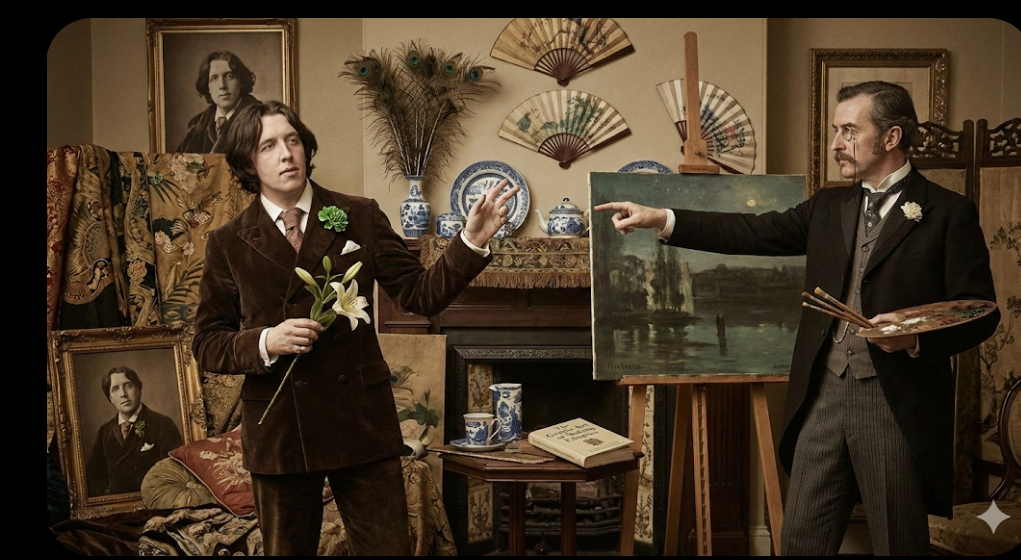
The Master and the Apostle
When Oscar Wilde arrived in London in the late 1870s, fresh from Oxford and full of aesthetic theories absorbed from Walter Pater and John Ruskin, James McNeill Whistler was already an established figure in the art world. The American-born painter had made London his home and was creating work that challenged every Victorian assumption about what art should be. His paintings bore titles like “Arrangement in Grey and Black” and “Nocturne in Blue and Gold”—musical terminology that emphasized formal qualities over narrative content. This was art for art’s sake, or as the French termed it, l’art pour l’art.
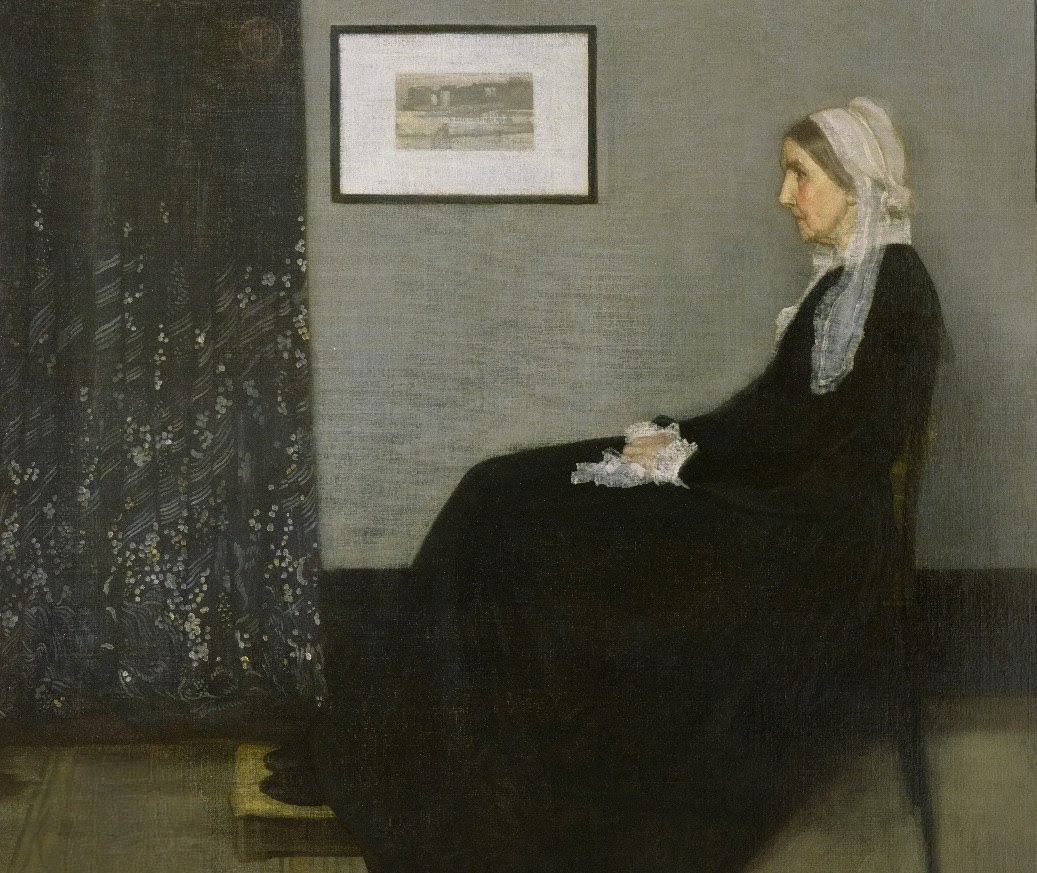
Whistler’s most famous painting, Arrangement in Grey and Black No. 1, is known to the world as “Whistler’s Mother.” But that sentimental title misses the entire point Whistler was making. By calling it an “arrangement,” he insisted that the formal elements—the composition, the tonal relationships, the subtle gradations of grey—mattered more than the fact that the subject happened to be his mother. This was revolutionary thinking in an age when art was expected to tell stories and convey moral lessons.
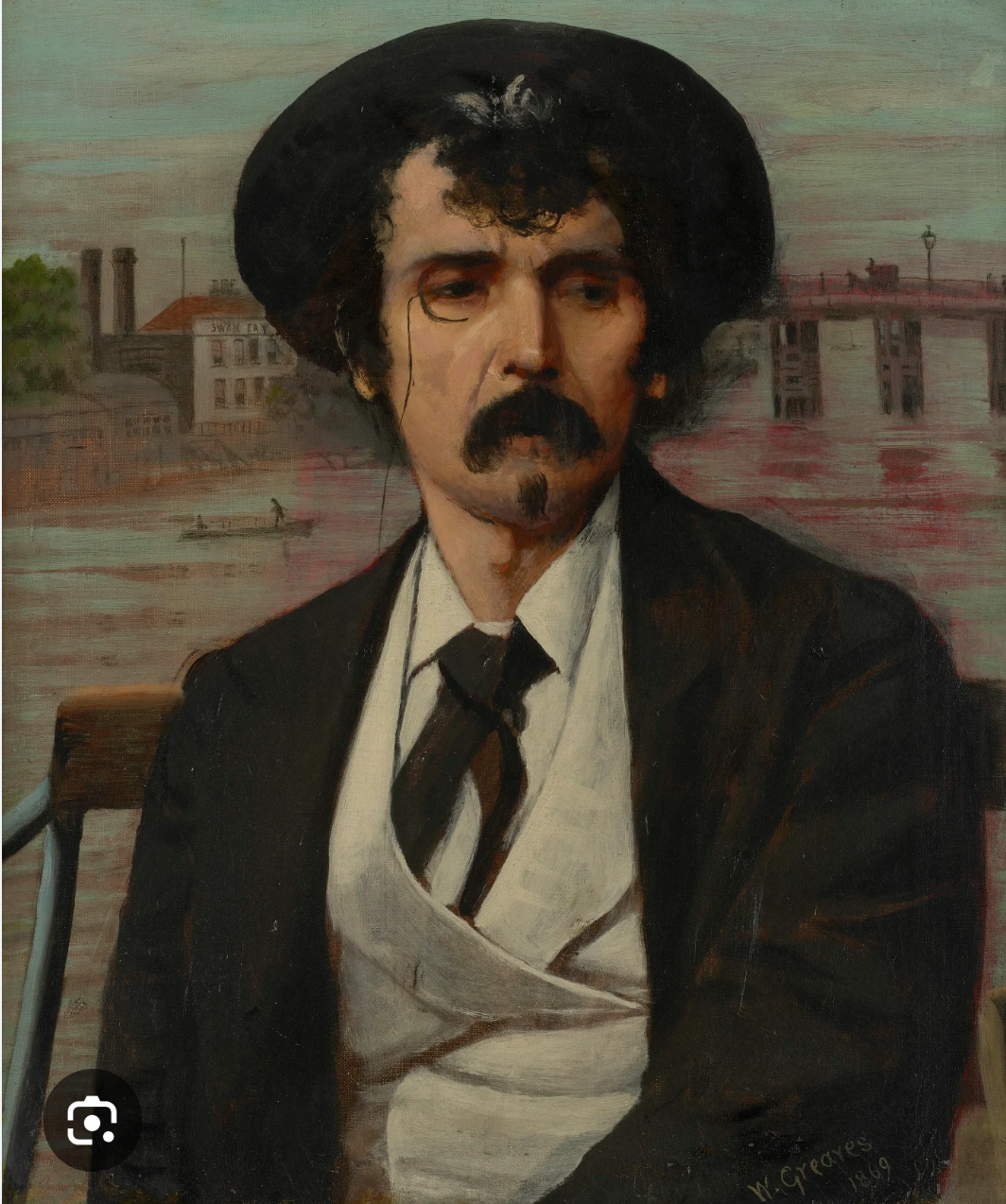
Oscar understood this instinctively. He had absorbed similar ideas at Oxford, but Whistler was actually living them, creating them, defending them in public. The two men met at the Grosvenor Gallery, that alternative exhibition space where the Aesthetic movement found its home. Whistler, with his trademark monocle and wide-brimmed hat, cutting a distinctive figure in London society. Oscar, younger and still finding his voice, dressed in the aesthetic style with his signature lily or sunflower boutonniere. They recognized kindred spirits in each other.
For anyone wanting to understand the full scope of Oscar’s aesthetic education and how it shaped his later work, Matthew Sturgis’s comprehensive biography Oscar: A Life provides invaluable context about this formative period.
The Ruskin Trial: A Turning Point
In 1878, something happened that would profoundly influence both men and the entire Aesthetic movement. The powerful art critic John Ruskin had written a devastating review of Whistler’s painting Nocturne in Black and Gold: The Falling Rocket, accusing the artist of “flinging a pot of paint in the public’s face.” Whistler sued him for libel.
Oscar Wilde was in the courtroom that day, watching as his aesthetic principles were literally put on trial. Whistler defended his right to create art that prioritized beauty and formal arrangement over moral instruction or photographic realism. The jury found in Whistler’s favor but awarded him only a farthing in damages—a pyrrhic victory that left him financially ruined by legal costs but morally vindicated in his artistic philosophy.
Paul Thomas Murphy’s Falling Rocket: The Battle of Modern Art thoroughly explores this pivotal trial and its impact on the development of modern art. For Oscar, watching Whistler defend art for art’s sake in court crystallized ideas he would later articulate in his own critical writing.
Shared Philosophy, Different Roles
What united Whistler and Wilde was their commitment to Aestheticism and their rejection of Victorian moral didacticism in art. Both believed that beauty needed no justification beyond itself. Both were influenced by Japonisme, that fascination with Japanese art and design that swept through artistic circles. Both understood that being an aesthete meant not just appreciating beauty but embodying it in how you dressed, decorated your home, and moved through the world.
But their roles in the movement were fundamentally different. Whistler was the practitioner, creating the paintings with their atmospheric Tonalist style and musical titles. Oscar became the interpreter and popularizer, the one who could explain these ideas to the public in brilliant, quotable prose. Whistler painted the Nocturnes; Oscar preached the gospel of beauty.
This division of labor worked well at first. Whistler was known for his caustic wit, and Oscar was developing his own gift for the perfectly turned phrase. They delighted in each other’s company, trading epigrams and observations at dinner parties. The aesthetic movement gained momentum, with both men at its forefront. Oscar dressed Constance, his wife, in the aesthetic style that drew so heavily from Whistler’s principles. Their homes became showcases of Japanese-influenced design, filled with blue and white porcelain, peacock feathers, and carefully arranged aesthetic objects.
The First Cracks Appear
The trouble began when Oscar started giving public lectures on art and aesthetics. He was a natural performer, charming audiences on both sides of the Atlantic with his wit and his theories about beauty. But Whistler began to notice something troubling: many of Oscar’s best lines sounded awfully familiar. Ideas Whistler had expressed in conversation were appearing, polished and perfected, in Oscar’s lectures.
That “You will, Oscar, you will” exchange wasn’t just banter—it was a warning shot. Whistler was noticing that his intellectual property, as we might call it now, was being borrowed without attribution. What seemed like friendly influence was starting to feel like theft.
In 1885, Whistler delivered his famous “Ten O’Clock Lecture,” a manifesto on art that laid out his aesthetic philosophy. Oscar attended and reviewed it positively, but he also gently disagreed with some points. Whistler was not pleased. The dynamic was shifting from master and admiring friend to rivals with competing claims to aesthetic authority.
The Falling Out
The relationship deteriorated rapidly through the mid-1880s. Whistler’s remarks about Oscar became increasingly barbed. He began referring to Oscar as his “pupil” in public, a designation Oscar found both inaccurate and insulting. When Oscar achieved success as a playwright and public intellectual, Whistler’s resentment grew more obvious.
The correspondence between them, preserved in Whistler’s book The Gentle Art of Making Enemies, shows the friendship curdling into mutual contempt. Whistler published their exchanges, complete with his butterfly signature marking each insult. He accused Oscar of being a parasite on genuine artistic talent, someone who talked brilliantly about art but created nothing himself.
One particularly cutting exchange concerned a production of one of Oscar’s plays. Whistler sent a telegram: “PUNCH too ridiculous—when you and I are together we never talk about Art.” Oscar’s reply was characteristically defensive and witty, but the hurt was evident beneath the polish.
Whistler’s attacks grew more personal and cruel. He called Oscar “the acolyte who shamelessly appropriated the Master’s theories.” In letters and public statements, he positioned himself as the original thinker and Oscar as merely a clever imitator, a popularizer who had stolen Whistler’s hard-won insights and presented them as his own.
Who Owned the Ideas?
The fundamental question at the heart of their dispute remains fascinating: where does influence end and plagiarism begin? Oscar never claimed to have invented Aestheticism. He acknowledged his debts to Pater, to Ruskin (despite their disagreements), to the French Symbolists, and yes, to Whistler. But he transformed what he learned, articulating it in ways that reached a much broader audience than Whistler’s paintings or prickly public statements ever could.
Whistler saw Oscar’s gift for language and public performance as fundamentally parasitical. He was the artist who had suffered for his principles, fought Ruskin in court, endured financial ruin for his beliefs. Oscar had simply shown up, borrowed the ideas, and become famous for expressing them beautifully.
Oscar, for his part, seemed genuinely puzzled by Whistler’s hostility. He had never hidden his admiration for Whistler’s work. He had championed the same aesthetic principles. If he expressed them in his own way, with his own distinctive voice, wasn’t that simply how culture worked? Ideas evolved, were shared, were transformed in the telling.
The dispute echoed an older tension in Whistler’s own circle. His pupil Walter Greaves had been criticized for imitating Whistler’s style too closely in his own paintings. But that was different, Whistler would have argued. Greaves was copying technique. Oscar was appropriating philosophy.
The Legacy of Bitterness
The feud never healed. Even after Oscar’s fall from grace following his trials and imprisonment, Whistler showed no sympathy. If anything, he seemed to take satisfaction in Oscar’s downfall, seeing it as vindication of his own judgment. The brilliant talker had finally been exposed, even if the exposure came through scandal rather than artistic inadequacy.
Whistler died in 1903, three years after Oscar. To the end, he maintained his position that Oscar had been a thief of ideas, a charming parasite who had built his reputation on borrowed brilliance. His book The Gentle Art of Making Enemies preserved that view for posterity, ensuring that their quarrel would be remembered alongside their contributions to the Aesthetic movement.
But history has been kinder to both men than they were to each other. We can appreciate Whistler’s revolutionary paintings and his courage in defending artistic autonomy. We can simultaneously value Oscar’s critical essays, his plays, and his gift for making aesthetic philosophy accessible and compelling. The ideas they fought over—that art needs no moral justification, that beauty has inherent value, that formal qualities matter as much as subject matter—became foundational to modern art, regardless of who deserves credit for first expressing them.
What Remains
Looking back at their relationship, what strikes me most is how unnecessary the bitterness became. These were two genuinely brilliant men who shared fundamental beliefs about art and beauty. They delighted in each other’s company before ego and rivalry poisoned everything. The Aesthetic movement was big enough for both of them, but neither could quite accept that.
Perhaps Whistler’s greatest fear was being forgotten, overshadowed by the more famous, more quotable Oscar Wilde. If so, that fear was unfounded. Both men left indelible marks on art and culture. Whistler’s Arrangement in Grey and Black remains one of the most recognized paintings in the world. His Nocturnes changed how we think about landscape painting. His defense of artistic autonomy paved the way for every subsequent modern art movement.
Oscar, despite Whistler’s accusations, created work that was distinctly his own. The Picture of Dorian Gray may owe debts to aesthetic philosophy, including ideas he encountered through Whistler, but the novel is unmistakably Wilde’s creation. His plays revolutionized English comedy. His critical essays remain brilliant explorations of art and life.
The butterfly and the sunflower, Whistler’s and Oscar’s respective aesthetic symbols, represented different approaches to the same fundamental beliefs. Whistler’s butterfly signature marked his letters with aristocratic delicacy. Oscar’s sunflower captured attention, turning its face toward beauty wherever it could be found. Both were necessary. Both enriched the culture of their time.
Their friendship failed, poisoned by jealousy and competing claims to originality. But the ideas they both championed—the ideas they fought over—outlived their quarrel. Beauty for its own sake, art that need not justify itself through moral instruction, the value of formal harmony and atmospheric suggestion over photographic realism—these concepts changed art forever.
When I look at that exchange—”I wish I’d said that, James.” “You will, Oscar, you will.”—I hear both affection and warning, friendship and rivalry, admiration and resentment. It contains their entire relationship in miniature: the shared delight in clever language, the competition for brilliance, and the inevitable collision between two massive egos who wanted the same thing—to be remembered as the voice of their age.
They both got their wish. We remember them still, butterfly and sunflower, painter and poet, locked in eternal argument over ideas that belonged, ultimately, to neither of them alone but to the movement they both helped create.
Further Reading
Explore more of the extraordinary people in Oscar Wilde’s life: