Bosie, Queensberry, and the Fall of Oscar Wilde
The story of Oscar Wilde’s downfall is usually told as a tragedy with one villain and one beloved friend. In reality it is messier, sadder, and more human: a triangle of wounded pride, furious respectability, and a love affair that was never built to survive the weight of the law.
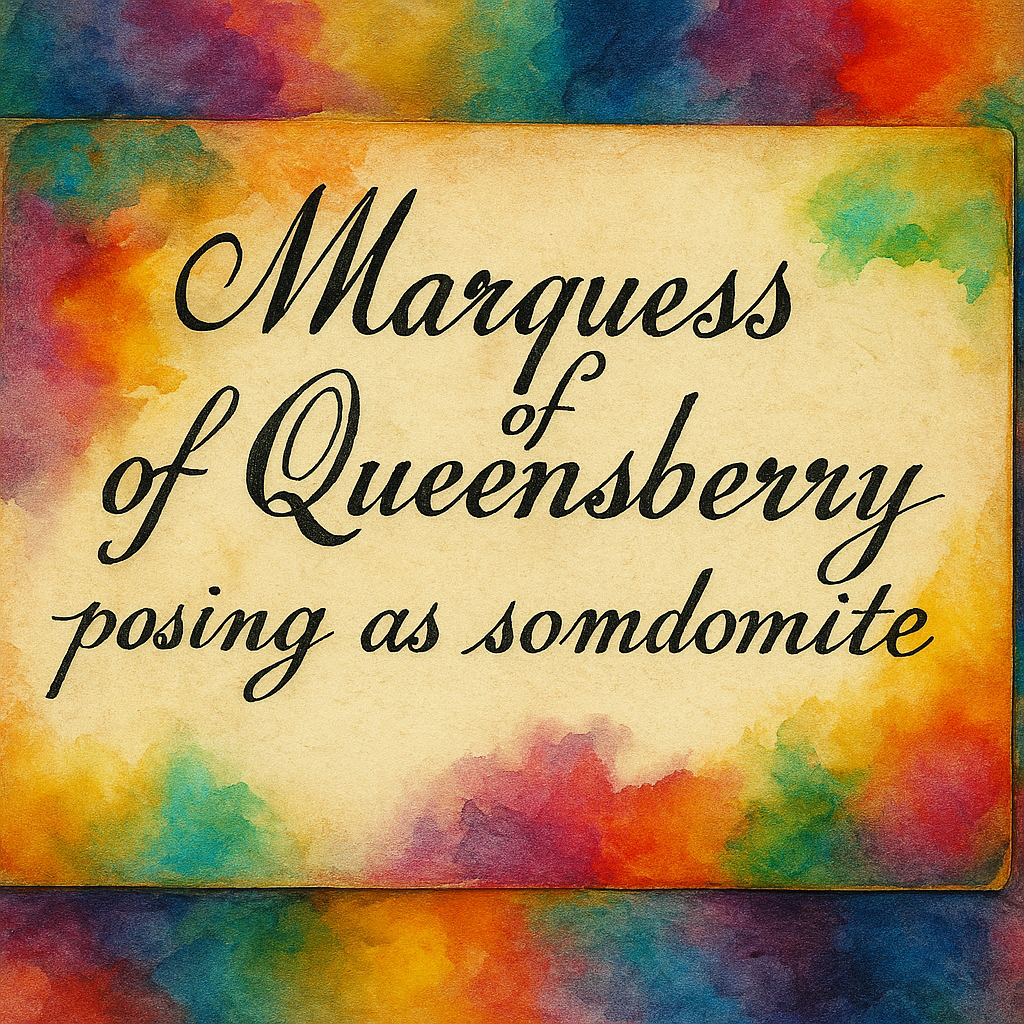
A colourful reimagining of the Marquess of Queensberry’s infamous calling card
A modern reimagining of Queensberry’s calling card – the spark that lit the fuse.
A love story written in green ink
When Wilde met Lord Alfred Douglas – “Bosie” to his friends – he was already the most fashionable writer in London. Bosie was younger, golden, charming, and dangerous: a brilliant student who spent more time on sonnets and champagne than on his degree. Wilde, who loved beauty and drama, fell hard. Bosie loved being adored by a genius and paraded through the West End by the wittiest man in England.
Their relationship burned hot and uneven. Bosie could be affectionate and generous; he could also be petulant, extravagant, and cruel. Wilde, older and more cautious, kept trying to turn their chaos into art – writing love letters in green ink, polishing pain into epigrams, paying off Bosie’s endless bills. The letters speak of real tenderness, but also of constant quarrels and reconciliations. They were not a calm couple; they were a storm.
Around them moved a circle of young men – some lovers, some friends, some simply curious about Wilde’s fame and Bosie’s money. In late–Victorian London, sex between men was criminal; the language for desire had to be coded. Wilde hid himself in paradox and performance. Bosie, reckless and furious with the world, refused to hide at all.
Queensberry enters the stage
Bosie’s father, John Sholto Douglas, Marquess of Queensberry, was the opposite of Wilde in almost every way. He was a boxing enthusiast, a man of volcanic temper, and proud of being blunt rather than clever. To him, Wilde was not only corrupting his son but mocking everything he believed about masculinity, class, and control.
Queensberry tried threats, confrontations, and scenes at theatres. Wilde, who hated vulgarity more than danger, usually met these with icy politeness. Bosie, who loathed his father, urged Wilde to fight back. The conflict escalated until February 1895, when Queensberry left his now–infamous calling card at Wilde’s club, accusing him of “posing as somdomite.”
It was more than an insult; it was an invitation to a duel in court. In Victorian Britain, honour and reputation were currency. Bosie pushed hard for a libel action, convinced that they could crush his father and humiliate him in public. Wilde’s friends and lawyers warned him that the case was dangerous. Wilde, haunted by the thought of being branded a coward, chose to sue.
The trial that should never have happened
Wilde’s libel action against Queensberry in April 1895 began as theatre. Wilde traded jokes with the prosecuting counsel; the gallery laughed. But the mood changed as letters were produced, witnesses were called, and Wilde was forced to explain his relationships with younger men in front of a hostile court.
The clever double–talk that worked at dinner tables could not save him here. Each epigram became, in the hands of the prosecution, a confession. When it became clear that Queensberry could prove that Wilde had indeed had sexual relationships with men, Wilde’s own lawyers abandoned the case. The libel action collapsed – but the damage was done. The evidence gathered to defend Queensberry was passed straight to the police.
Within days Wilde himself was arrested and charged with gross indecency. Bosie fled abroad. Queensberry, who had begun as a furious father, now saw himself as a moral crusader who had saved England from corruption. Wilde, who might still have escaped to France, stayed – partly from exhaustion, partly because he could not quite believe that the society which had applauded him would now destroy him.
Prison, blame, and the long aftermath
Wilde’s criminal trials ended with a guilty verdict and a sentence of two years’ hard labour. It broke his health, his finances, and much of his spirit. In prison he wrote the long letter later published as De Profundis, a work that is part confession, part accusation, and part spiritual autobiography. Bosie appears there as both beloved and destructive – “the danger and delight of my life.”
After Wilde’s release they briefly reunited in Italy, against the wishes of almost everyone who cared about them. The experiment failed. Old patterns of quarrels, money troubles, and jealousy snapped back into place. Wilde, tired and ill, finally let the relationship go. He died in Paris in 1900, aged only forty–six.
Bosie lived on for another half–century, reinventing himself as a Catholic convert, a minor poet, and – awkwardly – a man who sometimes spoke bitterly about Wilde and about queer people in general. Queensberry died convinced he had been right. Both men carried their own wounds: Bosie from a brutal family and a lifetime of scandal; Queensberry from grief, rage, and an idea of honour that could not bend.
How to read Bosie and Queensberry now
It is tempting to look for a single villain: to blame Bosie’s recklessness, or Queensberry’s hatred, or Wilde’s pride. But the fall of Oscar Wilde was the result of all three, amplified by a legal system that treated love between men as a crime and by a society that adored Wilde’s wit while quietly sharpening its knives.
Remembering that complexity matters. Bosie was not only a spoiled boy; he was also a gifted writer, shaped by a violent father and a culture that offered him almost no healthy script for desire. Queensberry was not only a bigot; he was also a man who genuinely believed – disastrously – that he was protecting his family. Wilde himself was not only a victim; he took a reckless gamble in the libel case, and it cost him everything.
What survives is the work. The plays, the stories, the essays, and the prison writings still speak more clearly than any witness box. In them Wilde refuses the idea that shame should have the last word. To read the history of Bosie and Queensberry alongside those texts is to see how much courage it took simply to be Oscar Wilde, and how much the world lost when it decided that wit, beauty, and love were crimes to be punished.
Wilde Reflections ✒️✨
“Every story deserves a reply — even those told in wit, wounds, and Wilde.”
Share your reflection, question, or favourite line below.