Constance Wilde: Author, Mother, and the Woman Behind Oscar Wilde’s Legend
In the spring of 1895, Constance Wilde’s world collapsed. Her husband Oscar stood trial for “gross indecency,” their home was seized by creditors, and friends who had once filled their Chelsea drawing room now crossed the street to avoid her. Yet this moment of public humiliation was only one chapter in the story of a woman who had been a published author, political activist, and pioneering advocate for women’s rights long before scandal touched her life.
Constance Wilde was never simply “Oscar’s wife,” though history has often reduced her to that role. She was an intellectual in her own right, a “New Woman” who campaigned for dress reform and women’s suffrage, published children’s books, and explored the esoteric mysteries of the Hermetic Order of the Golden Dawn. Her story—one of intelligence, resilience, and ultimately tragedy—deserves to be told on its own terms.
Early Life: Dublin to London
Constance Mary Lloyd was born on January 2, 1858, in Dublin, Ireland, into a world of Victorian respectability that would later prove far more fragile than it appeared. Her father, Horace Lloyd, was a barrister from a wealthy professional family. Her mother, Adelaide Atkinson, came from prosperous military stock. On paper, Constance’s childhood should have been one of privilege and security.
The reality was darker. Horace Lloyd was charged with exposing himself to nursemaids—a scandal the family managed to hush up, though it cast a shadow over the household. Adelaide was emotionally distant and erratic, offering little maternal warmth to her daughter. When Horace died in 1874, sixteen-year-old Constance was left with a difficult inheritance: wealth, yes, but also the psychological scars of a troubled home.
Despite these challenges, Constance was exceptionally well-educated for a woman of her time. She studied music, painting, and literature, becoming fluent in French and Italian. She read widely and thought independently, qualities that would later draw her to the emerging women’s rights movement. By her early twenties, she had become what Victorians called a “New Woman”—financially independent, intellectually curious, and unwilling to accept the limitations society placed on her sex.
Her family connections would eventually bring her to London, where she moved in fashionable artistic circles. It was here, in 1881, that she met the man who would change her life forever.
Meeting Oscar: A Meeting of Minds
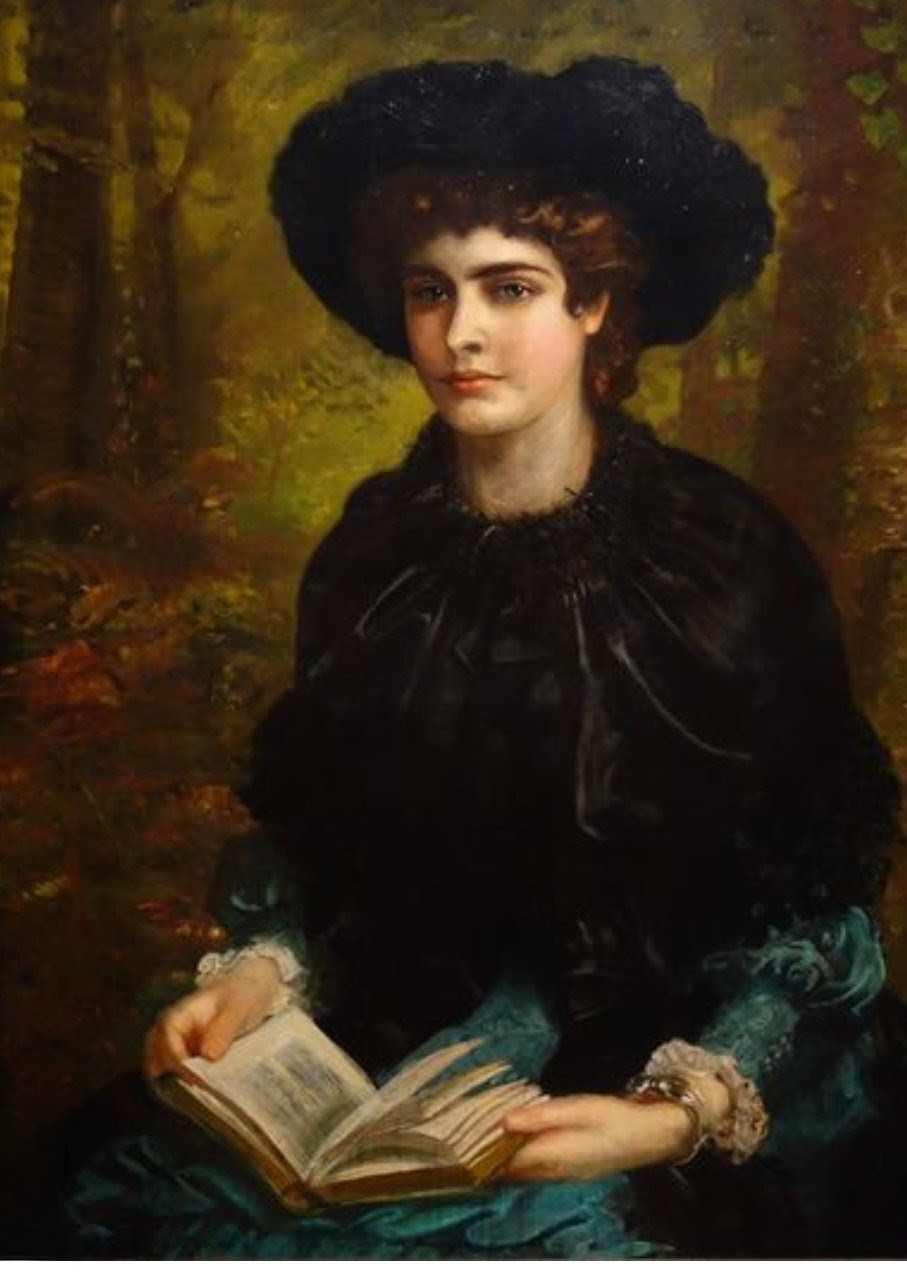
Oscar Wilde was already making a name for himself as an aesthete and wit when he encountered Constance Lloyd at a London gathering in 1881. She was beautiful—slender, with grave, quiet eyes that seemed to see through superficiality. More importantly for Oscar, she was intelligent, well-read, and sympathetic to the artistic ideals he championed.
For Constance, Oscar must have seemed like a breath of fresh air. He was brilliant, charming, and utterly unlike the conventional men her family might have chosen for her. He quoted poetry, challenged social norms, and promised a life filled with art, beauty, and intellectual adventure.
They married on May 29, 1884, and settled into what would become one of London’s most famous addresses: 16 Tite Street in Chelsea, known as the “House Beautiful.” The home was decorated in the Aesthetic style—oriental wallpapers, blue china, peacock feathers—and became a salon for artists, writers, and society figures. These early years appear to have been genuinely happy. Oscar described Constance’s “grave, quiet eyes” with tenderness, and she supported his work enthusiastically, even collaborating with him on projects.
The couple had two sons: Cyril, born in 1885, and Vyvyan, born in 1886. Constance was a devoted mother, though she also continued to pursue her own intellectual interests. But after Vyvyan’s birth, the physical intimacy of their marriage declined sharply. It was around this time that Oscar began exploring relationships with men—a path that would eventually lead to catastrophe.
Yet even as the marriage’s romantic dimension faded, Constance remained Oscar’s partner in the world of ideas and art. She had her own career to build, and she threw herself into it with remarkable energy.
A Woman of Many Talents
Constance Wilde was far more than a society wife. She was a working writer, political activist, and social reformer who left her own mark on Victorian London—though her achievements have often been overshadowed by her husband’s fame.
Her most visible campaign was for dress reform. As an active member of the Rational Dress Society, Constance fought against the restrictive corsets that literally reshaped women’s bodies and damaged their health. She edited the society’s gazette and wore “aesthetic dress”—loose-fitting, flowing garments that scandalized conventional Victorians but allowed women to move and breathe freely. This was radical stuff for the 1880s, and Constance threw herself into the cause with conviction.
She was equally passionate about women’s political rights. Long before women’s suffrage became a mainstream cause, Constance was advocating for women to sit in Parliament and participate fully in public life. She was active in Liberal Party politics and used her social position to promote progressive causes.
As a writer, Constance published two collections of children’s stories: There Was Once (1888), which she illustrated herself with Oscar’s help, and A Long Time Ago (1892). These fairy tales reflected the Aesthetic Movement’s values—beauty, imagination, moral instruction delivered through art rather than sermon. She also edited Oscariana, a collection of her husband’s aphorisms and witticisms, helping to build his literary reputation.
Perhaps most intriguingly, Constance was a founding member of the Hermetic Order of the Golden Dawn, a mystical society that explored esoteric spirituality, ritual magic, and ancient wisdom. Her “pioneering and questioning spirit,” as Franny Moyle describes in her authoritative biography Constance: The Tragic and Scandalous Life of Mrs Oscar Wilde, drew her to explore the controversial and unconventional aspects of late Victorian culture.
Constance was living proof that a woman could be a mother, a writer, a political activist, and a spiritual seeker all at once. She had built a life of purpose and meaning—until everything came crashing down.
The Scandal of 1895
The Wilde family’s destruction began with a calling card. In February 1895, the Marquess of Queensberry—father of Lord Alfred Douglas, Oscar’s lover—left a card at Oscar’s club with the words “For Oscar Wilde, posing somdomite” [sic]. Oscar, against all advice, sued Queensberry for criminal libel.
It was a catastrophic mistake. The trial exposed Oscar’s relationships with young men, and when the libel case collapsed, criminal charges followed. Oscar was arrested, tried, and convicted of “gross indecency.” He was sentenced to two years’ hard labor.
For Constance, the scandal was annihilating. Friends abandoned her overnight. Creditors seized the House Beautiful and auctioned off everything inside—furniture, books, artwork, even the children’s toys. She had no home, no money, and no social standing. The woman who had once hosted London’s artistic elite was now a pariah.
Her family urged her to divorce Oscar immediately and cut all ties. Constance refused. Despite everything, she still cared for the man she had married. She sent him money in prison and seems to have hoped, at least initially, that some kind of reconciliation might be possible after his release.
But she was adamant about one thing: protecting her sons. To shield Cyril and Vyvyan from the stigma of their father’s name, she changed the family surname to Holland, an old name from her own family line. She moved the boys to Switzerland and later to Germany, far from the British press and the whispers of scandal.
She forced Oscar to give up his parental rights—a devastating blow for him, but one she felt was necessary. The boys would grow up never knowing their father.
Exile and Illness
The years following Oscar’s conviction were marked by exile, poverty, and declining health. Constance lived modestly on the Continent with her sons, moving between Switzerland, Germany, and Italy. She never saw Oscar again after his release from prison in 1897, though they exchanged letters.
For years, Constance had suffered from a mysterious illness characterized by lameness, extreme fatigue, and debilitating pain. Victorian doctors, baffled by her symptoms, attributed them to “nervousness” or vaguely defined “uterine problems”—the catch-all diagnoses for women’s ailments in that era.
Based on letters and medical records later examined by her grandson Merlin Holland and modern medical researchers, it is now widely believed that Constance suffered from Multiple Sclerosis (MS). The progressive paralysis, the periods of remission and relapse, the chronic pain—all fit the pattern of MS, though the disease would not be properly understood for decades.
In 1898, desperate for relief, Constance sought help from an Italian surgeon named Luigi Maria Bossi in Genoa. Bossi believed her paralysis was caused by a uterine tumor and recommended surgery. It was a tragic miscalculation. The operation—likely unnecessary—killed her, probably through sepsis or intestinal obstruction. She died on April 7, 1898, at just forty years old.
A Grave in Genoa
Constance Wilde is buried in the Monumental Cemetery of Staglieno in Genoa, Italy—far from the Ireland of her birth and the London of her brief triumph.
Her tombstone originally bore no mention of Oscar Wilde. It wasn’t until the 1960s that the words “Wife of Oscar Wilde” were added to her grave—a small acknowledgment of the connection that had defined so much of her life, for better and worse.
Oscar himself visited her grave in 1900, shortly before his own death. He was deeply shaken. “It was very tragic seeing her name carved on a tomb,” he wrote. “I was deeply affected—with a sense, also, of the uselessness of all regrets.”
It was as close as he would come to an apology.
Legacy: More Than a Footnote
Constance Wilde’s sons both survived to adulthood, though Cyril was killed in action during World War I in 1915. Vyvyan lived until 1967 and wrote movingly about his mother in his memoir Son of Oscar Wilde, helping to rescue her reputation from obscurity.
For too long, Constance has been treated as a footnote in Oscar Wilde’s biography—the wronged wife, the abandoned woman, the tragic victim. Franny Moyle’s groundbreaking biography, drawing on over three hundred of Constance’s unpublished letters, has done much to restore her to her rightful place as a fascinating figure in her own right.
Constance was a woman who advocated for political and social change decades before it became acceptable. She was a published author, a fashion reformer, a spiritual seeker, and a devoted mother who made impossible choices to protect her children. She endured public humiliation, financial ruin, chronic illness, and exile—and through it all, she maintained her dignity and her independence.
She deserves to be remembered not just as the woman who loved Oscar Wilde, but as Constance Lloyd Holland: author, activist, and a woman who lived boldly in an age that demanded women be small.
Further Reading & Resources
If Constance’s story has moved you and you want to explore her life in greater depth, these books offer valuable perspectives:
- Constance: The Tragic and Scandalous Life of Mrs Oscar Wilde by Franny Moyle – The definitive modern biography, based on extensive primary research
- Oscar Wilde by Richard Ellmann – The classic, compassionate Pulitzer Prize-winning biography that includes Constance’s perspective
- Son of Oscar Wilde by Vyvyan Holland – A memoir by Constance’s younger son