De Profundis: Oscar Wilde’s Letter from the Depths
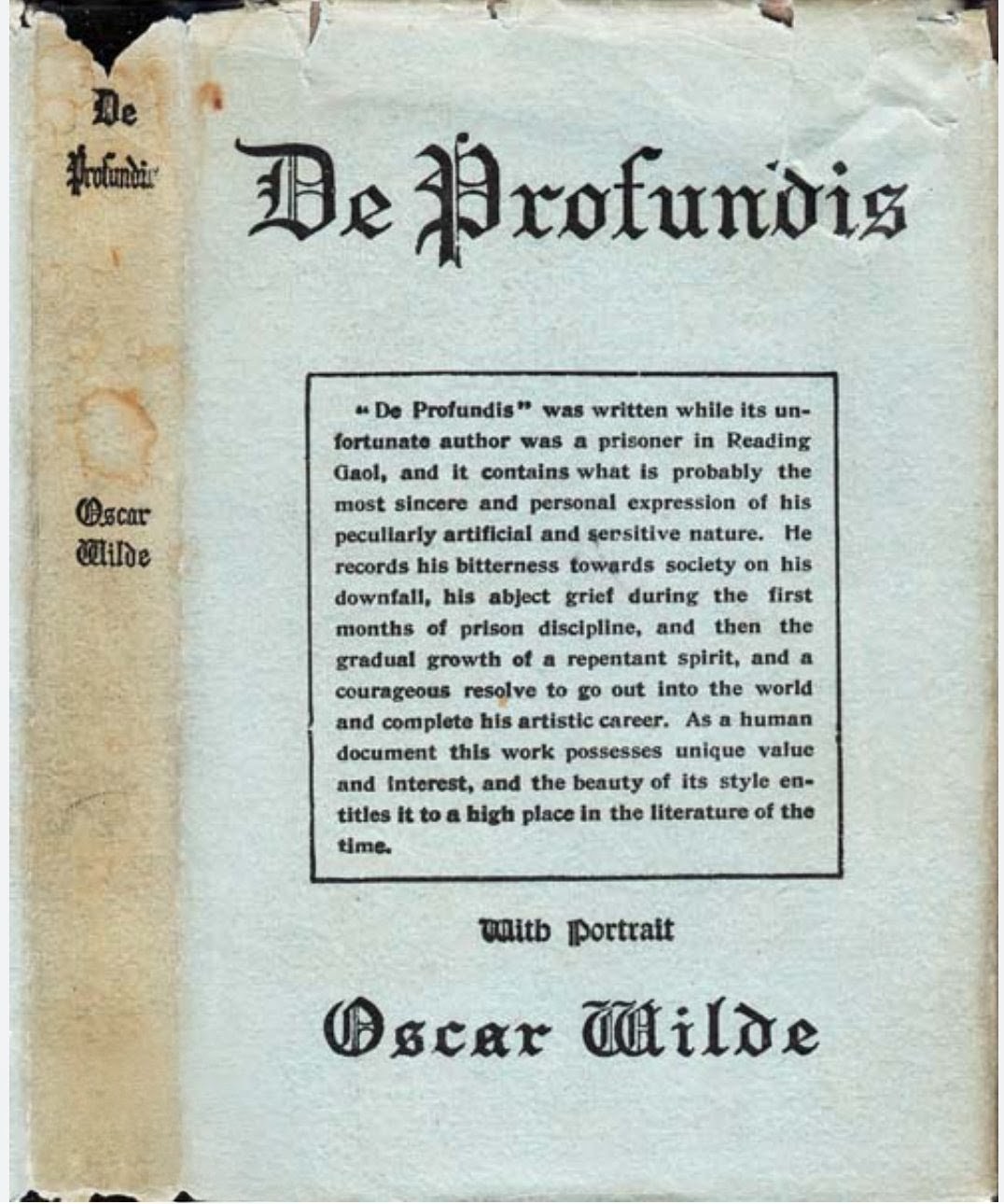
De Profundis: Oscar Wilde’s Prison Letter to Lord Alfred Douglas
The devastating 80-page letter written in Reading Gaol that became a time-bomb haunting Robert Ross for years
On the morning of 20 May 1897, as the cross-Channel steamer pulled into Dieppe harbor, Oscar Wilde approached Robert Ross with a large sealed envelope. “This, my dear Robbie,” he said, “is the great manuscript about which you know.” As he handed it over, he broke into what Ross later described as “a sort of Rabelaisian laugh.”1
Neither man could have realized the terrible symbolism in this simple act of transfer. Ross had just accepted custody of what would become one of the most significant documents in Victorian literature—and a time-bomb that would explode with devastating effect fifteen years later.
A Letter Written in Hell
De Profundis—Latin for “from the depths”—began as a letter. Not just any letter, but an eighty-page reckoning written by a broken man to the young aristocrat who had helped destroy him.
Oscar Wilde started writing to Lord Alfred Douglas in January 1897, during his final months in Reading Gaol. He had already served nearly two years of hard labor for “gross indecency.” His health was shattered, his wife had obtained a legal separation, his children had been taken from him by court order, and he faced release as an undischarged bankrupt with no prospect of earning a living in England again.
The prison authorities, by special dispensation, allowed him to write this extended letter to Douglas. Under normal prison regulations, Wilde had been forbidden to speak to fellow prisoners, kept in solitary confinement with severely limited writing materials. This letter became both an outlet for two years of enforced silence and an attempt to make sense of the catastrophe his life had become.
What the Letter Contains
De Profundis is many things simultaneously: a love letter, an accusation, a spiritual meditation, and a work of literary criticism. Wilde moves between blaming Douglas for his downfall and examining his own complicity. He reflects on suffering, art, and the nature of Christ. He analyzes his own plays and writes about beauty and sorrow with the same aesthetic precision he once applied to lighter subjects.
The letter catalogues Douglas’s behavior during their relationship: his extravagance, his temper, his demands on Wilde’s time and money, his refusal to leave England when it became clear their association was dangerous. Wilde writes of how Douglas’s feud with his father, the Marquess of Queensberry, had used Wilde as a weapon, ultimately destroying him.
But the letter is also deeply personal. Wilde acknowledges his own weakness, his inability to break free from Douglas despite knowing the relationship was destructive. He writes about his children, his lost home, his ruined reputation. And throughout, he attempts to find meaning in his suffering, to transform his degradation into something spiritually and artistically valuable.
The Instructions That Were Never Followed
Before finishing the letter, Wilde had written to Ross from prison with specific instructions. He wanted Ross to have several typescript copies made, then send the original to Douglas.
Ross never sent it.
Whether from loyalty to Wilde, concern about Douglas’s reaction, or simple prudence, Ross kept the manuscript. He had two typescript copies made as requested, but the original—written on prison-issue blue foolscap paper—remained in his possession.
This decision would have consequences neither man foresaw. Douglas never received the letter Wilde had written to him. He never read Wilde’s account of their relationship, never had the opportunity to respond to the accusations or understand the depth of Wilde’s feelings. When portions of De Profundis were eventually published, Douglas was blindsided—and furious.
From Private Letter to Public Document
Ross gradually revealed the letter’s contents. In 1905, he published an edited version with Methuen, removing all references to Douglas and the personal relationship. This version presented De Profundis as Wilde’s spiritual meditation on suffering and art, not as the deeply personal accusation it actually was.
The full, unexpurgated text wasn’t published until 1962, long after both Ross and Douglas were dead. By then, it had become impossible to separate the literary work from the personal attack, the spiritual reflection from the bitter recrimination.
The Explosion
Holland’s description of the manuscript as a “time-bomb” proved prophetic. When Douglas eventually learned the full contents of the letter, he accused Ross of manipulating Wilde’s legacy and distorting his memory. The dispute became increasingly bitter and public.
In 1914, Douglas sued Arthur Ransome for libel after Ransome published a biography of Wilde that drew on De Profundis. The trial exposed much of the letter’s contents for the first time, and Douglas lost the case. The verdict effectively validated Ross’s handling of the manuscript and Wilde’s account of their relationship.
But the personal cost to Ross was enormous. The trial revived all the old scandals, subjected him to vicious cross-examination about his own sexuality, and drained him financially and emotionally. He died in 1918, worn down by years of defending Wilde’s legacy and battling Douglas.
In handing Ross that sealed envelope on the boat to Dieppe, Wilde had—whether intentionally or not—demanded that his most loyal friend should share the consequences of his destruction. Ross accepted the burden out of love and devotion. It would haunt him for the rest of his life.
Literary Significance
Despite—or perhaps because of—its origins in personal catastrophe, De Profundis stands as one of Wilde’s most significant works. It shows a different Wilde from the witty playwright or the aesthetic theorist. This is Wilde stripped of artifice, writing from genuine suffering.
The prose style remains characteristically beautiful, but the tone is unlike anything else he wrote. There’s anger here, and bitterness, but also moments of genuine spiritual insight. Wilde’s attempt to find meaning in his degradation, to transform his suffering into art, gives the letter a rawness and authenticity that makes it difficult to read even now.
Critics have debated whether De Profundis succeeds as either a personal letter or a literary work. As a letter, it’s too performative, too aware of posterity. As literature, it’s too bound to specific circumstances, too personal to achieve universality. Yet it remains compelling precisely because of this tension between the private and the public, the personal and the artistic.
The Manuscript Today
The original manuscript, in Wilde’s handwriting on prison paper, is now held in the British Library. It stands as a physical reminder of the conditions under which it was written—a literary masterpiece created in a prison cell by a man who had lost everything.
When Wilde handed that sealed envelope to Ross on the Dieppe boat, laughing his “Rabelaisian laugh,” he was passing on more than a manuscript. He was transferring the burden of his legacy, the responsibility for how his story would be told, and the weight of his relationship with Douglas.
Ross accepted it all. In doing so, he ensured that De Profundis would survive—but at a cost neither man could have imagined that bright May morning in 1897.
The title “De Profundis” was not Wilde’s own but was given to the work by Robert Ross when he first published it in 1905. The phrase comes from Psalm 130: “Out of the depths have I cried unto thee, O Lord.”
Related Articles
Further Reading
- De Profundis by Oscar Wilde – Read the letter itself
- After Oscar: The Legacy of a Scandal by Merlin Holland – Comprehensive account of what happened to Wilde’s family and legacy after his death
References
- Merlin Holland, After Oscar: The Legacy of a Scandal (London: Fourth Estate, 2016)